
Compound Interest: The Force Behind Both Savings Growth and Debt Spirals
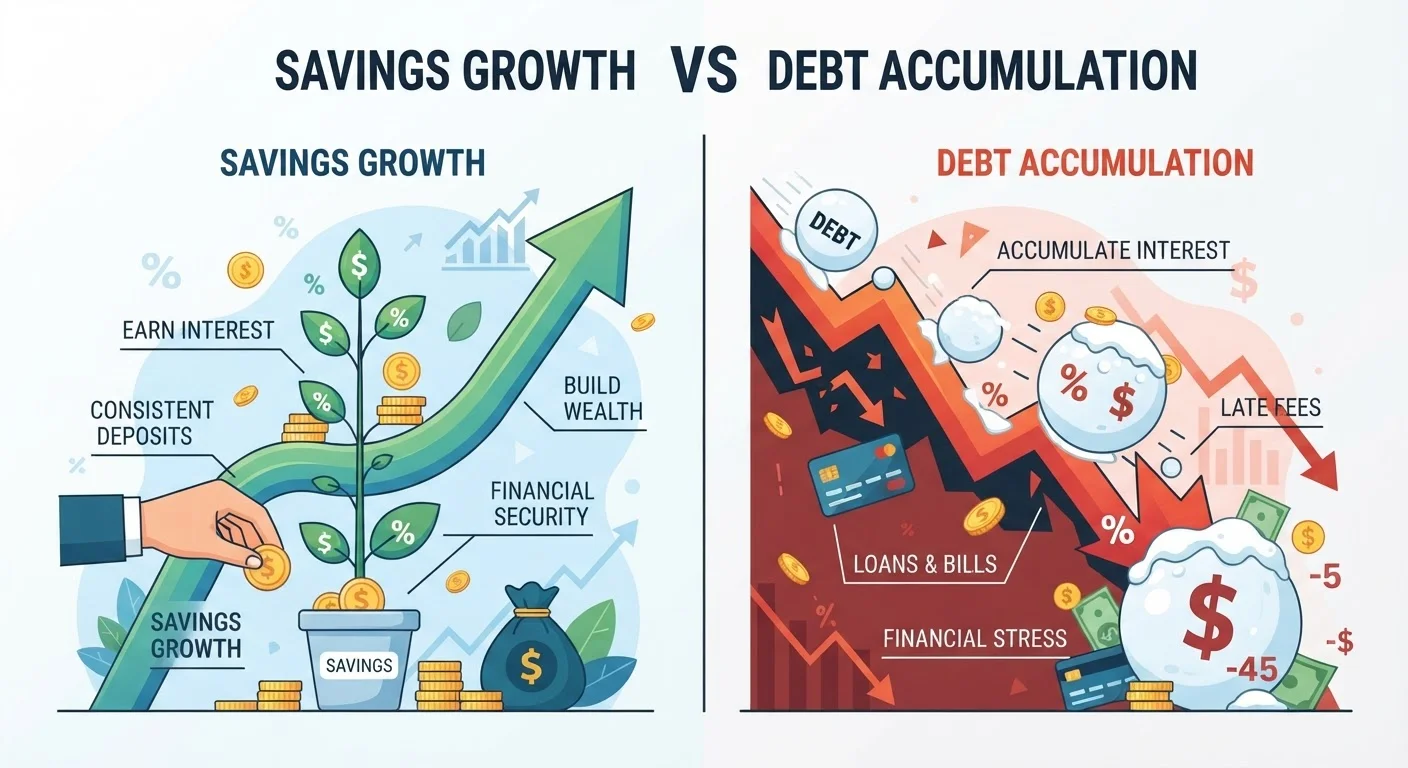
Photo credit: ResultsPoint.net | Find The Required Information
In this article
Compound interest works for you in savings accounts and against you in debt. Learn how it actually works in plain language.
Key Takeaways
- Compound interest accelerates growth in savings by earning returns on previously earned interest.
- The same mechanism causes debt balances to snowball when interest is not paid down promptly.
- Time is the most powerful variable — starting earlier dramatically amplifies compounding's effect.
- High-interest debt, like credit cards, compounds frequently and can outpace savings growth.
- Understanding compounding helps you make more informed decisions about saving and debt repayment.
How Compounding Actually Works
Imagine you deposit $1,000 into a savings account earning 5% interest per year, compounded annually. After year one, you earn $50 in interest, bringing your balance to $1,050. In year two, you earn 5% on $1,050 — not on the original $1,000 — so you earn $52.50. By year three, you're earning interest on $1,102.50.
That gap between earning on the original amount versus earning on the growing total is the entire engine of compounding. It seems small at first. Over decades, it becomes the difference between a modest cushion and a substantial one.
The same math applies in reverse when you owe money. If you carry a $1,000 balance on a credit card charging 20% interest and don't pay it down, that interest gets added to your balance — and next month, you're paying interest on a larger number than you started with.
20%+
Typical credit card APR in the U.S.
According to Federal Reserve data, average credit card interest rates have exceeded 20% in recent years, making high-frequency compounding especially costly for cardholders carrying balances.
Daily
How often many credit cards compound interest
Most credit card issuers calculate interest on a daily basis, meaning unpaid balances begin accruing new charges immediately — accelerating debt growth compared to monthly compounding.
2x+
Balance growth over 20 years at 5% compounded annually
A principal amount left to compound at 5% annually more than doubles in roughly 20 years, illustrating the long-term power of compounding on savings.
When Compounding Grows Your Savings
In savings and investment accounts, compounding is the mechanism that makes long-term saving so powerful. The two factors that most determine how much you accumulate are the interest rate and, above all, time.
Someone who begins contributing to a savings account at 25 and stops at 35 can end up with more money at retirement than someone who starts at 35 and contributes steadily until 65 — assuming similar rates of return. That counterintuitive outcome is compounding at work across a longer time horizon.
Check Your APY, Not Just the Rate
When comparing savings accounts, look at the Annual Percentage Yield (APY) rather than just the stated interest rate. APY accounts for how often interest compounds, giving you a more accurate picture of what you'll actually earn over a year. Two accounts with the same stated rate but different compounding frequencies will produce different results.
If you're weighing account types, the annual percentage yield (APY) — which reflects compounding frequency — is more useful than the stated interest rate alone. Learn how different account types compare when it comes to the yields they actually deliver.
When Compounding Works Against You
Debt with a high interest rate — especially credit cards, which commonly carry rates well above 20% — can compound daily. That means the interest added today becomes part of tomorrow's balance before you've had a chance to pay it.
Minimum payments are designed to cover interest charges and a small slice of principal. When you pay only the minimum, the bulk of the balance remains, and compounding continues on that larger number. Balances can persist for years — and cost far more in total interest than the original purchase price.
This is one reason that understanding the basics of debt repayment matters so much. Knowing what's happening to your balance mechanically helps you see why paying more than the minimum — even a modest amount more — can substantially reduce total interest paid and time to payoff.
Making Compounding Work in Your Favor
The practical takeaway isn't complicated, even if the math has nuance. On the savings side: start as early as you can, contribute consistently, and leave the money alone to compound. On the debt side: prioritize reducing high-interest balances quickly, because every dollar of principal you eliminate stops generating compounded interest charges.
If you're managing both savings and debt simultaneously, the interest rates on each matter a lot. Saving while carrying debt involves real tradeoffs, and the math doesn't always point clearly in one direction. Similarly, paying off debt early versus building savings simultaneously is a decision worth thinking through carefully rather than assuming one approach fits all situations.
Compound interest is not magic, and it's not a trick. It's a straightforward mechanic — one that rewards patience and consistency when it's on your side, and penalizes inaction when it isn't.
Compounding Frequency Varies by Product
Not all accounts compound at the same frequency. Savings accounts often compound daily or monthly, while some bonds or CDs may compound semi-annually or annually. When comparing financial products, confirming the compounding frequency — not just the rate — helps you make a more accurate comparison. This is general information; verify specifics with your financial institution.
For a broader look at the financial concepts that connect to compounding — including liquidity and diversification — see the financial planning concepts every adult should understand.
This article is for general informational and educational purposes only and does not constitute personalized financial, investment, tax, or legal advice. Consult a qualified financial professional before making decisions about your own financial situation.
Frequently Asked Questions

Author
Finance Editorial Team
Finance Editorial Team is the collective byline for our editorial team and contributor network. Articles published under this byline or an editorial pen name are researched, written, and reviewed according to our editorial standards for clarity, consistency, and independence before publication.
View all articles →