
What Happens Inside an Engine During a Cold Start
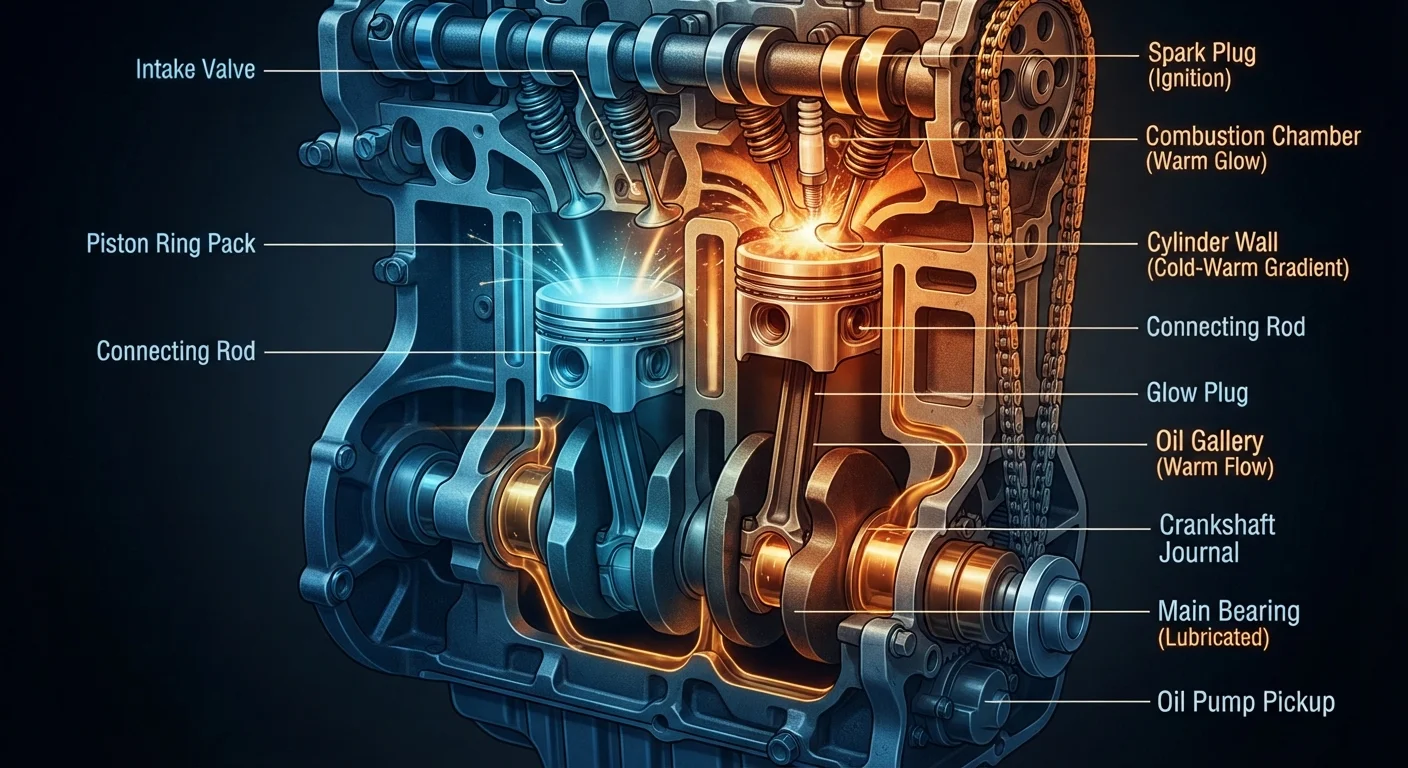
Photo credit: ResultsPoint.net | Find The Required Information
In this article
Those first seconds after turning the key put unique stress on engine components. Understanding cold starts helps explain why warm-up habits matter.
Key Takeaways
- Engine oil takes several seconds to circulate after a cold start, leaving metal surfaces briefly under-lubricated.
- Metal engine components start slightly contracted and expand as heat builds — clearances tighten as temperature rises.
- The ECU automatically enriches the fuel mixture at cold start to compensate for poor fuel vaporization.
- Most cold-start engine wear happens in the first 20–30 seconds before oil pressure fully stabilizes.
- Gentle driving for the first few minutes is more effective than extended idling for reaching operating temperature.
The First Few Seconds: Where the Stress Concentrates
Turn the key on a cold morning and a lot happens at once. The starter motor cranks the engine, the ECU fires the injectors with a richer-than-normal fuel mixture, and the crankshaft begins spinning — all before a single drop of oil has moved far from where it settled overnight.
Oil follows gravity. After hours of sitting, most of it drains down to the oil pan at the bottom of the engine. The oil pump immediately begins pulling it back up through a network of passages and galleries to coat bearings, camshafts, cylinder walls, and valve train components. That process takes anywhere from a few seconds to around 20–30 seconds depending on the engine design, oil viscosity, and temperature. During that window, metal is moving against metal with only a thin residual film for protection. This brief period accounts for a disproportionate share of long-term engine wear.
Match Your Oil Viscosity to the Season
Using the correct oil viscosity for your climate matters most during cold starts. Thinner cold-weather viscosities — like 0W-20 versus 5W-30 — flow to critical surfaces faster when temperatures drop. Always check your owner's manual for the manufacturer's recommendation rather than defaulting to whatever is on the shelf.
Using the correct oil viscosity for your climate matters most during cold starts. Thinner cold-weather viscosities — like 0W-20 versus 5W-30 — flow to critical surfaces faster when temperatures drop. Check your owner's manual for the manufacturer's recommendation.
Metal Expansion and Combustion Chamber Dynamics
Every metal component in your engine was engineered with specific tolerances — gaps between the piston and cylinder wall, between the crankshaft and its bearings, between valve stems and guides. Those tolerances assume the engine is at operating temperature, typically between 195°F and 220°F for the coolant. At a cold start, everything is slightly contracted. Clearances are a fraction of a millimeter larger than intended.
As the engine warms, those gaps close toward their designed specs. Running hard before that happens — aggressive acceleration, high RPM — risks uneven wear because the geometry is still settling. This is the mechanical reason that gentle driving for the first few minutes protects your engine more than simply sitting at idle.
In the combustion chamber, cold temperatures create their own challenge. Gasoline vaporizes less completely when it's cold, which means droplets of liquid fuel can reach the cylinder walls and dilute the oil film there — a phenomenon called fuel dilution. The ECU compensates by increasing fuel delivery and advancing ignition timing, but some degree of this is unavoidable on a cold start.
Idling Is Not the Same as Warming Up
A common misconception is that letting a car idle for several minutes fully prepares the engine. In reality, an idling engine warms up slowly and never exercises the transmission, wheel bearings, or tires. Light driving at low RPM warms the entire drivetrain more effectively. Extended idling also increases fuel consumption and, in enclosed spaces, poses a carbon monoxide risk.
What the ECU Does Automatically
Modern engines manage the cold-start challenge largely without driver input. The engine control unit monitors coolant temperature and adjusts several parameters simultaneously:
- Fuel injection quantity: More fuel is added to the mixture to ensure reliable ignition when vaporization is poor.
- Idle speed: The ECU holds a higher idle — often 1,000–1,500 RPM — until the engine approaches operating temperature, then tapers it back to normal.
- Ignition timing: Timing is adjusted to promote stable combustion with a richer, colder mixture.
- Emissions controls: The catalytic converter needs heat to function. The ECU may retard timing slightly to generate extra heat and bring the converter up to operating temperature faster.
This is why older carbureted engines, which lacked electronic management, required a manual choke to richen the mixture on cold mornings. Today's systems handle it automatically — and more precisely.
Understanding these mechanics also puts routine maintenance in sharper context. Fresh oil of the correct grade, a healthy battery, and clean fuel injectors all reduce cold-start stress. For a broader look at how maintenance costs fit into vehicle ownership, see the financial side of owning your first car. And since cold-weather conditions amplify every cold-start challenge, seasonal car prep is worth reviewing before temperatures drop.
~30 sec
Time for oil pressure to fully stabilize after a cold start
Engineering estimates vary by engine design and oil viscosity, but most sources place full oil circulation within 20–30 seconds of startup.
50%+
Share of engine wear attributed to cold-start conditions
Industry and engineering literature commonly cites cold starts as responsible for a disproportionate share of overall engine wear over a vehicle's lifetime.
195–220°F
Typical engine coolant operating temperature range
Most gasoline passenger car engines are designed to run efficiently within this coolant temperature band, which takes several minutes of driving to reach.
Frequently Asked Questions

Author
Autos Editorial Team
Autos Editorial Team is the collective byline for our editorial team and contributor network. Articles published under this byline or an editorial pen name are researched, written, and reviewed according to our editorial standards for clarity, consistency, and independence before publication.
View all articles →