
What Deferred Maintenance Actually Does to a House Over Time
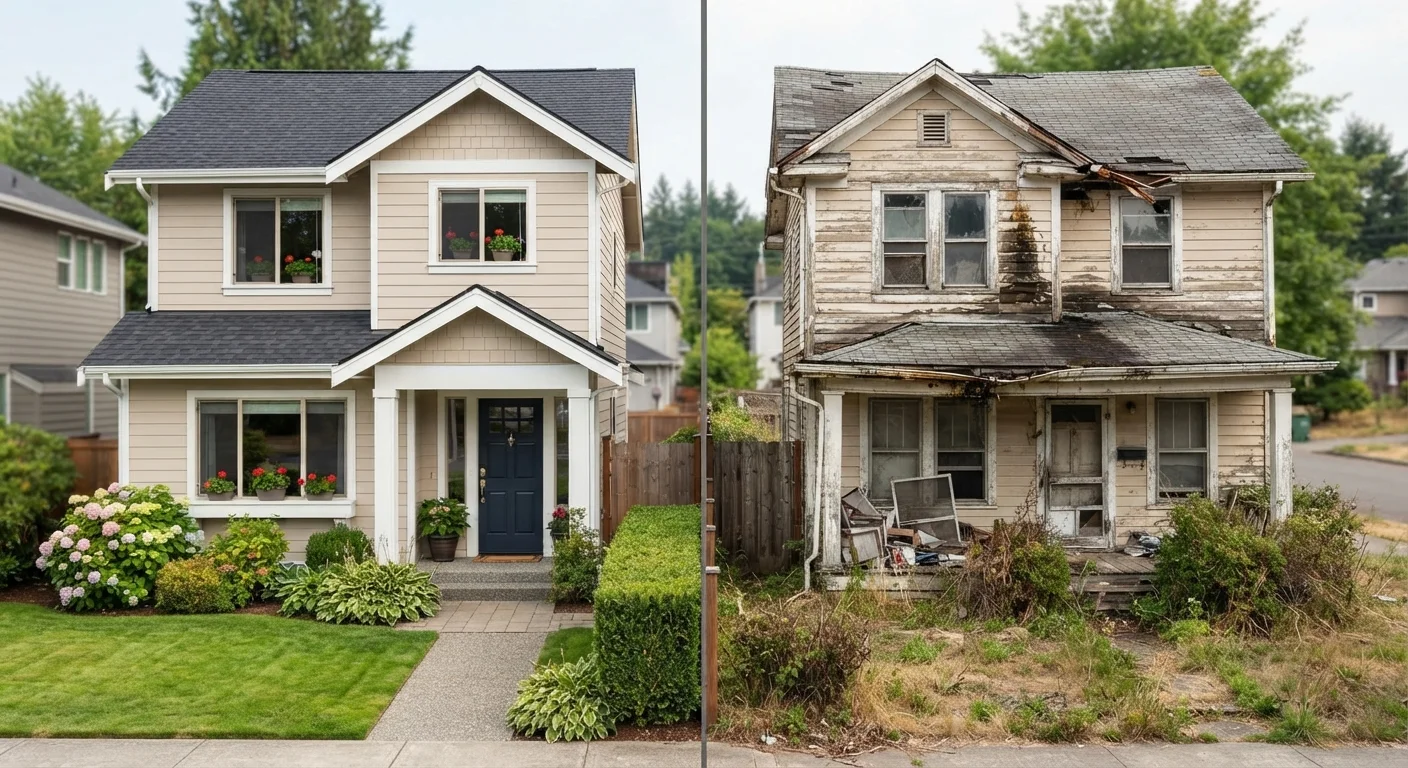
Photo credit: ResultsPoint.net | Find The Required Information
In this article
Skipping routine upkeep rarely saves money. Here's how neglected tasks compound into structural and safety problems.
Key Takeaways
- Skipping routine maintenance rarely saves money — it almost always shifts costs into the future at a higher price.
- Water intrusion is the single fastest driver of compounding home damage.
- Many maintenance failures follow a predictable chain: one neglected system stresses the next.
- Some deferred maintenance crosses into safety territory, including fire and structural hazards.
- Early, inexpensive interventions consistently outperform reactive repairs.
How Neglect Compounds: The Chain Reaction Model
Deferred maintenance rarely fails in isolation. When one building system is neglected, it tends to stress adjacent systems — creating a chain reaction that multiplies repair costs and complexity. Understanding this pattern helps homeowners see why small delays carry outsized consequences.
A straightforward example: gutters clogged with debris overflow during rain, directing water against the foundation. Over months, that moisture infiltrates the soil around the footing, hydrostatic pressure builds, and basement walls develop cracks. Water enters, humidity rises, wood framing begins to rot, and mold follows. A $150 gutter cleaning at the start of this chain could have prevented thousands of dollars in foundation and framing repair.
This cascade effect applies across nearly every home system. An unserviced HVAC unit runs harder to compensate for reduced efficiency, shortening the compressor's life. A cracked caulk joint around a window frame allows air and moisture infiltration that damages the rough opening, the interior drywall, and eventually the paint finish. The compounding nature of deferred maintenance is well-documented in real estate and property management contexts.
1 in 4
Homes show signs of deferred maintenance at resale
Home inspection industry data consistently finds deferred maintenance among the most common issues flagged in pre-sale inspections.
3–5×
Estimated cost multiplier of reactive vs. preventive repair
Industry estimates suggest that reactive repairs for neglected systems can cost three to five times more than the preventive maintenance that would have prevented them.
24–48 hrs
Time for mold to begin growing on wet structural materials
The EPA notes that mold can begin developing on wet building materials within one to two days under favorable temperature and humidity conditions.
Water: The Fastest Driver of Damage
Of all the forces that damage a home, water is the most relentless and the least forgiving of neglect. It exploits every gap, crack, and failed sealant — and it works continuously.
Roof maintenance is the highest-leverage defense. Missing or curled shingles allow water to reach the underlayment; if that underlayment is also compromised, water contacts the sheathing directly. Wet sheathing can develop mold within 24 to 48 hours under the right conditions and begin to lose structural integrity within weeks. By the time a homeowner notices a ceiling stain, the damage above it is often already severe.
Window and door caulking degrades with seasonal temperature swings. A gap that seems cosmetic is actually an open channel for wind-driven rain. Similarly, grading around the home's foundation — the slope of soil away from the house — settles over time and can reverse, funneling rain directly toward the structure.
A Simple Annual Water Audit
Once a year — ideally in early spring — walk your home's perimeter after a heavy rain. Look for pooling water near the foundation, overflowing or sagging gutters, and any discoloration on siding or trim. Inside, check ceilings and cabinet bases under sinks for soft spots or staining. Catching these signs early is far less costly than discovering them during a sale or after a wet winter.
Owners of older properties face additional complexity, since aging materials may fail faster. The article keeping an older home in good shape addresses the specific vulnerabilities of pre-1980 construction.
Safety Hazards That Develop Silently
Some deferred maintenance crosses from expensive into dangerous. These failure modes deserve particular urgency.
- Dryer vent buildup: Lint accumulation in vent ducts is a leading cause of residential fires. Vents should be cleared at least annually.
- GFCI outlet failures: Ground fault circuit interrupter outlets in kitchens, bathrooms, and garages protect against electrical shock. They have a limited lifespan and should be tested periodically.
- Carbon monoxide sources: Furnaces, water heaters, and gas appliances that go unserviced can develop cracks in heat exchangers or flues, allowing carbon monoxide — an odorless, colorless gas — to enter living spaces.
- Structural deck deterioration: Deck ledger boards and post bases are frequent victims of moisture damage. Failures can occur without warning and pose serious injury risk.
None of these hazards announce themselves visibly in early stages. Routine inspection — rather than waiting for symptoms — is the only reliable defense.
Making Upkeep Manageable Before It Becomes Urgent
The practical challenge most homeowners face isn't ignorance of maintenance needs — it's prioritization when time and money feel limited. Not all tasks carry the same urgency, and triage matters.
A useful mental model is to separate maintenance into three categories: life-safety (smoke detectors, CO detectors, electrical and gas systems), water and structure (roof, gutters, foundation drainage, caulking), and mechanical efficiency (HVAC, water heater, appliances). Life-safety and water/structure tasks should essentially never be deferred. Mechanical tasks can often be scheduled rather than handled reactively.
For homeowners working within tight financial constraints, prioritizing the most critical maintenance tasks is a skill in itself — and one that can prevent small gaps from becoming emergencies. The home improvement resources available to homeowners today also include many practical guides for low-cost preventive work.
When to Call a Professional
Some maintenance tasks — cleaning gutters, replacing caulk, testing outlets — are well within DIY reach for many homeowners. Others, including anything involving the electrical panel, gas lines, structural members, or roofing at height, carry real safety risk and often require permits and licensed contractors. When in doubt about the scope of a problem, a professional inspection is money well spent.
This article provides general home maintenance education and is not a substitute for a professional home inspection or the advice of a licensed contractor. Always verify local code requirements and consult qualified professionals for structural, electrical, or mechanical work.
Frequently Asked Questions

Author
Home Editorial Team
Home Editorial Team is the collective byline for our editorial team and contributor network. Articles published under this byline or an editorial pen name are researched, written, and reviewed according to our editorial standards for clarity, consistency, and independence before publication.
View all articles →