
Shared vs. Dedicated Internet: Understanding the Difference Between Connection Types
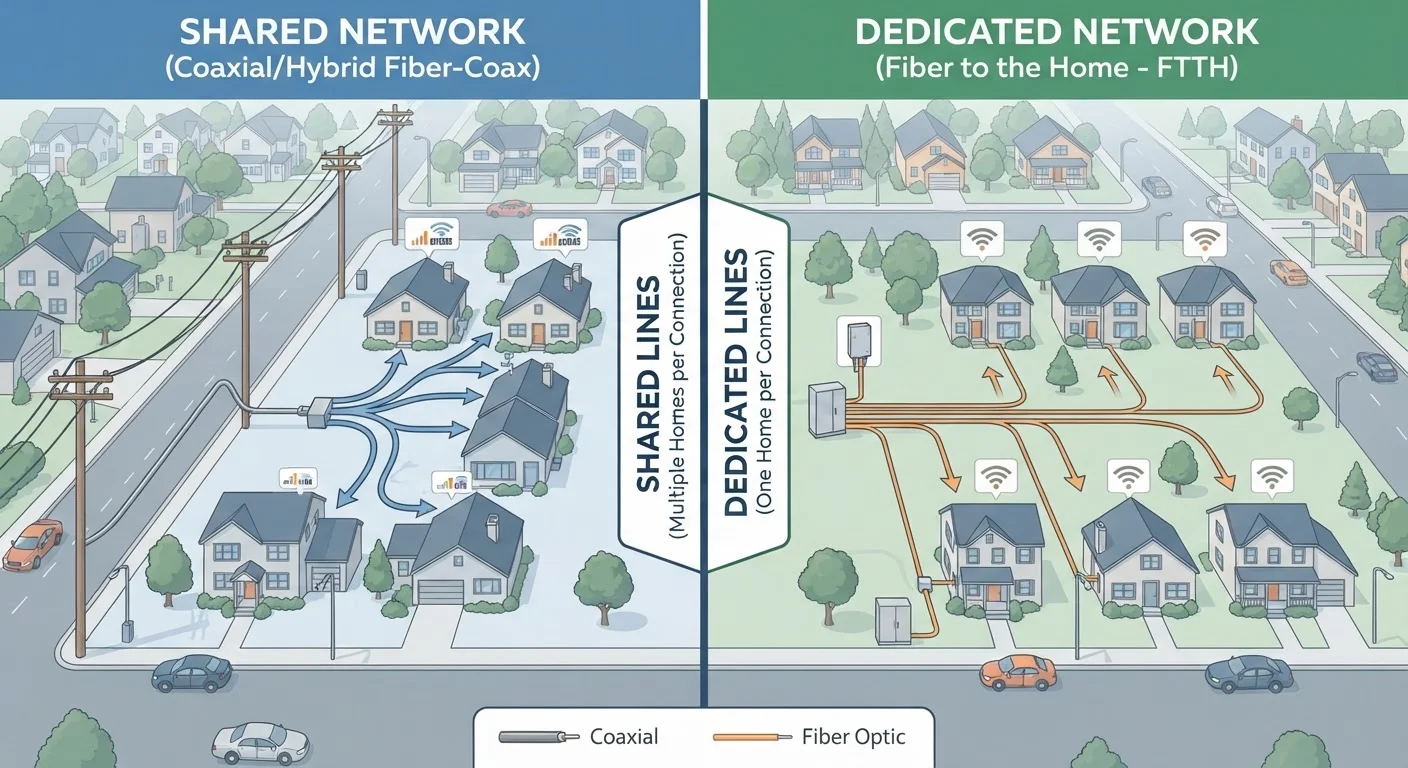
Photo credit: ResultsPoint.net | Find The Required Information
In this article
Cable internet is shared with neighbors; fiber is often dedicated. Learn what that means for your speeds during peak hours.
Key Takeaways
- Cable internet shares bandwidth among nearby households; fiber connections are typically dedicated to your home.
- Shared connections can slow down noticeably during peak evening hours when many neighbors are online simultaneously.
- Dedicated connections deliver more consistent speeds regardless of neighborhood usage patterns.
- Fiber availability is still limited in many areas, making cable a practical default for millions of households.
- Your plan's advertised speed is a maximum — actual speeds depend heavily on connection type and network congestion.
What 'Shared' Actually Means for Your Home Connection
Think of shared internet like a water main running down your street. Every house that taps into it is drawing from the same pipe. Cable internet works on a similar principle: a single line feeds a cluster of homes in your neighborhood, and every household on that segment shares the available capacity.
During quiet hours — say, a Tuesday morning — that shared capacity is rarely a problem. But when everyone gets home in the evening and starts streaming, gaming, or joining video calls at the same time, that shared pipe gets crowded. The result is what many people experience as the "7 p.m. slowdown" — speeds that feel noticeably sluggish compared to earlier in the day.
This isn't a flaw unique to any one provider. It's a structural feature of how cable networks are built. Advertised speeds rarely reflect real-world performance, and network congestion on shared infrastructure is one of the most common culprits.
| Criterion | Shared Internet (Cable) | Dedicated Internet (Fiber) |
|---|---|---|
| Bandwidth sharing | Shared with nearby homes | Dedicated to your home |
| Peak-hour performance | Can slow down significantly | Generally stays consistent |
| Upload speeds | Much slower than download | Often matches download speed |
| Availability | Widely available across the U.S. | Limited; expanding gradually |
| Infrastructure | Coaxial cable (shared node) | Fiber optic (individual line) |
| Best use case | Light to moderate household use | Heavy use, remote work, gaming |
What 'Dedicated' Means — and Why Fiber Is Usually the Example
A dedicated internet connection means the bandwidth running into your home isn't shared with your neighbors. You have your own lane. Fiber-optic internet is the most common example of this in the residential market, though the term "dedicated" more precisely describes how the connection is provisioned than the physical cable type.
Because fiber typically brings a dedicated line to each home — sometimes called FTTH, or fiber to the home — your speeds stay stable whether it's 2 a.m. or 8 p.m. on a Sunday. There's no neighborhood congestion pool to compete with.
Fiber also tends to offer symmetrical speeds, meaning your upload speed matches your download speed. Cable connections usually have much slower upload speeds by design — which matters more than most people realize until they're on a video call or backing up files to the cloud. For a deeper look at how these two technologies differ at a structural level, see Fiber vs. Cable Internet: What Sets Them Apart for Home Users.
~50%
U.S. addresses with fiber access
Estimates from industry and government sources suggest roughly half of U.S. homes can access fiber-optic internet, though coverage varies significantly by region.
10–20%
Typical cable speed drop during peak hours
FCC Measuring Broadband America reports have documented measurable speed reductions on cable networks during high-demand evening periods compared to off-peak times.
1:1
Fiber upload-to-download speed ratio
Fiber plans commonly offer symmetrical speeds, while cable upload speeds are typically a fraction of download speeds by network design.
Does the Difference Actually Matter for Most Households?
For casual users — people who browse, stream the occasional show, and check email — a shared cable connection often performs well enough that the distinction is invisible. Congestion tends to hit hardest when multiple people in a household are doing bandwidth-intensive things at the same time the rest of the neighborhood is, too.
But as more households run smart devices, stream in 4K, and include someone working or schooling from home, the margin for congestion shrinks. A dedicated connection removes that variable entirely.
Availability is the other major factor. Fiber reaches roughly half of U.S. addresses, depending on the source and year of the estimate — meaning cable remains the practical reality for tens of millions of households. Understanding what you're working with helps set realistic expectations and informs decisions like choosing a higher-tier plan to offset peak-hour dips. For a plain-language overview of all connection types, Home Internet Explained is a useful starting point.
A Note on 'Dedicated' in Marketing Language
Some providers use the word 'dedicated' loosely in advertising without it meaning a fully unshared line to your home. If consistent speeds matter to you, it's worth asking specifically whether the connection is fiber to the home (FTTH) or whether it involves any shared segment. Common myths about home internet speed covers how marketing language can blur these distinctions.

Author
Tech Editorial Team
Tech Editorial Team is the collective byline for our editorial team and contributor network. Articles published under this byline or an editorial pen name are researched, written, and reviewed according to our editorial standards for clarity, consistency, and independence before publication.
View all articles →