
Roundabouts vs. Four-Way Stops: Which Is Safer and Why
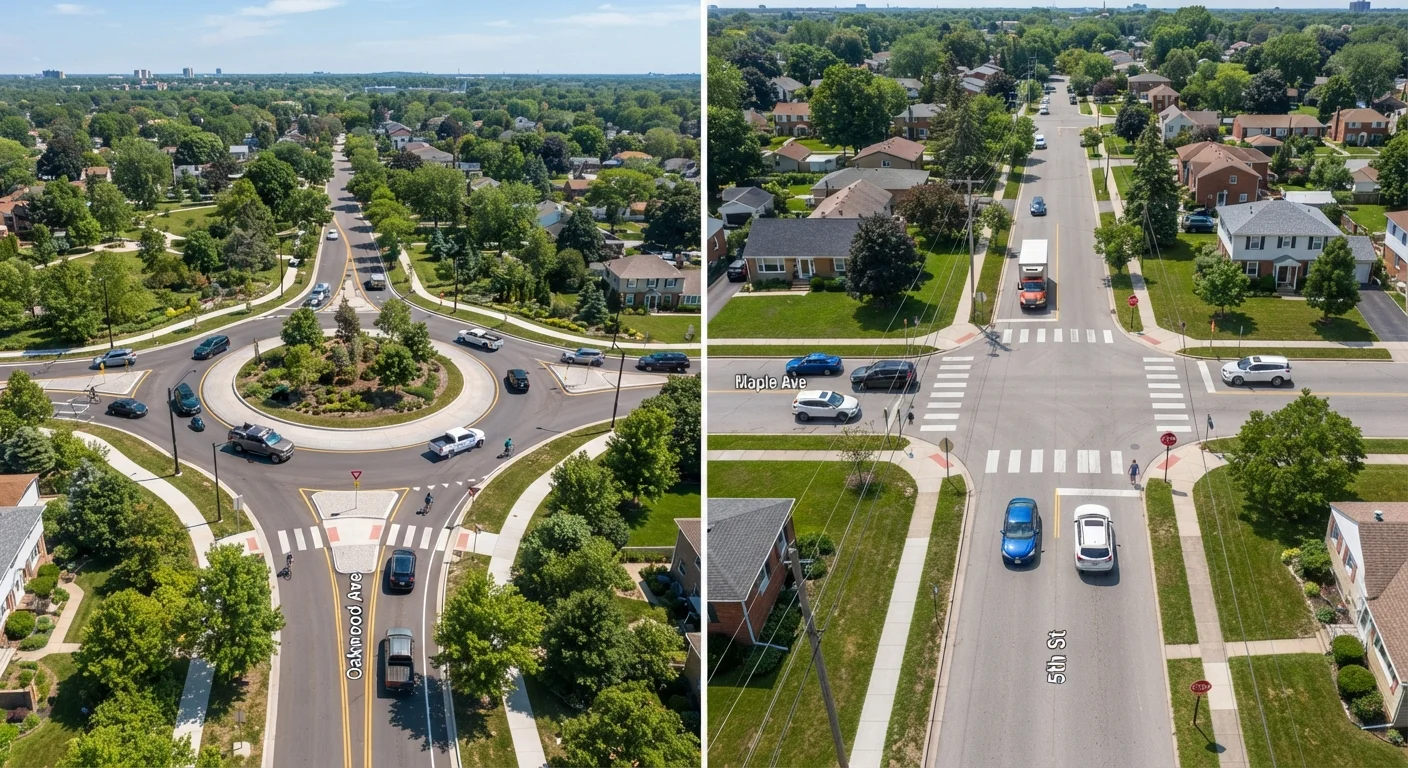
Photo credit: ResultsPoint.net | Find The Required Information
In this article
Traffic engineers often prefer roundabouts, but many drivers find them confusing. A clear look at how each intersection type handles risk.
Key Takeaways
- Roundabouts eliminate the most dangerous crash types — head-on and high-speed right-angle collisions — by design.
- Four-way stops rely on drivers correctly following right-of-way rules, which introduces human-error risk.
- Research from the Insurance Institute for Highway Safety shows roundabouts reduce fatal and injury crashes significantly compared to conventional intersections.
- Roundabouts can feel unfamiliar but operate on a simple rule: yield to traffic already in the circle.
- Neither intersection type is universally better — context, traffic volume, and local conditions all matter.
How Each Intersection Type Works
A four-way stop brings every approaching vehicle to a complete halt, then uses right-of-way rules to determine who goes next — generally, first to arrive goes first, with ties broken by yielding to the driver on the right. Simple in concept, but it depends heavily on every driver understanding and following those rules correctly.
A roundabout works differently. Vehicles enter a one-way circular roadway, yield to traffic already circulating, and exit at their desired street. There are no traffic signals and no opposing left turns. The geometry itself does the work — speeds drop naturally because of the curve, and crash angles are dramatically reduced.
The key mechanical difference: four-way stops create stop-and-go decision points at right angles, while roundabouts convert those right-angle paths into glancing, low-speed merges. That distinction has significant safety consequences.
The Safety Data Comparison
The evidence here is fairly clear. The Insurance Institute for Highway Safety (IIHS) has found that converting conventional intersections to roundabouts reduces injury crashes by roughly 75% and fatal crashes by up to 90% at those locations. That's not a marginal improvement — it reflects a fundamental change in the types of crashes that can occur.
| Criterion | Roundabout | Four-Way Stop |
|---|---|---|
| Crash severity | Significantly lower — no head-on collisions | Higher risk of right-angle T-bone crashes |
| Traffic flow | Continuous; no full stops required | Stop-and-go; all vehicles halt |
| Driver rule complexity | One rule: yield to circulating traffic | Right-of-way rules; tie-breaking judgment required |
| Construction cost | Higher — requires more land and engineering | Lower — stop signs and pavement markings only |
| Pedestrian crossings | On approach roads; lower-speed encounters | Defined crossing moments when all traffic is stopped |
| Best volume range | Moderate to high traffic intersections | Low to moderate traffic intersections |
Four-way stops are not dangerous by definition, but they rely on consistent human behavior. Drivers who misjudge turn order, roll through without fully stopping, or are distracted at the moment of decision create the exact conditions that lead to T-bone collisions — one of the most injury-prone crash types on any road.
~75%
Reduction in injury crashes at converted intersections
According to the Insurance Institute for Highway Safety (IIHS), roundabouts significantly cut injury crash rates compared to conventional intersections.
Up to 90%
Reduction in fatal crashes at roundabout conversions
IIHS research on intersections converted from signals or stop signs to roundabouts found dramatic reductions in fatal crash frequency.
~40%
Reduction in all crashes at roundabouts
The Federal Highway Administration has cited overall crash reductions across multiple roundabout installation studies in the United States.
For everyday drivers building safer habits, understanding what the intersection demands of you is part of the equation. As explored in safe driving habits that experienced drivers rely on, scanning the intersection early and committing to a clear approach reduces risk regardless of intersection type.
Why Roundabouts Confuse Drivers — and How to Navigate Them
Most driver confusion at roundabouts comes from unfamiliarity, not complexity. The actual rule is straightforward: yield to vehicles already in the circle, then enter when clear. Signal your exit as you approach your street.
Common mistakes include entering without yielding, stopping inside the circle (don't — keep moving), and failing to signal an exit. Multi-lane roundabouts add a layer — choose your lane before entering based on your intended exit, much like a highway interchange.
Multi-Lane Roundabouts: Choose Your Lane Early
Multi-lane roundabouts follow the same yield rule but require lane selection before you enter. Generally, the right lane is for exits in the first half of the circle and the left lane for exits further around. Check local signage — markings vary by location. Getting into the correct lane on approach eliminates most mid-circle confusion.
Pedestrian crossings at roundabouts are placed on the approach roads, not inside the circle. This positioning is deliberate: drivers enter and exit at lower speeds and are focused on one direction at a time. Still, pedestrians and cyclists should treat roundabout crossings with care, as sightlines differ from conventional intersections.
Concerns about blind spots are worth keeping in mind when checking for cyclists on roundabout approaches — especially when exiting.
When a Four-Way Stop Still Makes Sense
Roundabouts require space, construction investment, and driver adaptation. In lower-traffic residential streets, school zones, or rural crossroads where volumes are modest and speeds are already low, a four-way stop is a practical, proven solution that requires no infrastructure overhaul.
Four-way stops also create clear, predictable pedestrian crossing moments — every vehicle is stopped. For areas with heavy foot traffic or where crossing time for elderly or mobility-impaired pedestrians is a priority, that defined pause can be an advantage.
The bottom line: traffic engineers generally favor roundabouts where space and volume justify them, but the right answer depends on the specific intersection. For drivers, both require attention and respect — and maintaining proper following distance on approach gives you more reaction time no matter which type you encounter.

Author
Autos Editorial Team
Autos Editorial Team is the collective byline for our editorial team and contributor network. Articles published under this byline or an editorial pen name are researched, written, and reviewed according to our editorial standards for clarity, consistency, and independence before publication.
View all articles →